Overview
Achieving stable, energy-efficient bipedal locomotion in underactuated robotic systems requires precise impulse control during double-support transition phases. This ongoing research project investigates the dynamic effects of pneumatic ankle push-off actuation on planar bipedal walking without knee joints.
By combining low-level continuous-time control models with high-level trajectory optimization, this work establishes a unified modeling, simulation, and experimental framework built from scratch. The system is evaluated across multiple initial configurations and desired step sizes using both PID and Model Predictive Control (MPC) to ensure gait stability and robust step tracking.
System Setup & Project Information
- Timeline: May 2026 – July 2027
- Guide: Prof. Arpita Sinha (Systems and Control Engineering, IIT Bombay)
- Co-Guide: Prof. Vivek Sangwan (Department of Mechanical Engineering, IIT Bombay)
- Primary Objective: Analyze the dynamic influence of active ankle push-off on underactuated planar bipedal gait stability under varying control architectures.
State & Dynamic Formulation
The planar biped is modeled as an underactuated link system subject to discrete stance-to-swing impact dynamics and impulsive ankle push-off forces. The generalized continuous-time equations of motion are expressed as:
\[M(q)\ddot{q} + C(q, \dot{q})\dot{q} + G(q) = B u + J^T F_{\text{push}}\]where:
- $q = [\theta_{\text{stance}}, \theta_{\text{swing}}]^T$ represents the vector of joint angular positions.
- $M(q)$ is the mass and inertia matrix.
- $C(q, \dot{q})$ captures Coriolis and centrifugal forces.
- $G(q)$ is the gravitational vector.
- $u$ denotes the control inputs, and $F_{\text{push}}$ represents the impulsive force generated by the pneumatic ankle actuator during double-support transitions.
Control & Modeling Framework
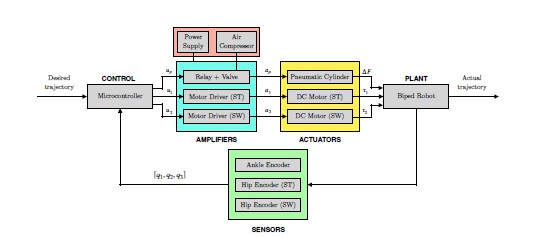
Figure 1: Control system flow diagram illustrating MPC trajectory generation and dSPACE hardware characterization loop.
Control Approaches
- Proportional-Integral-Derivative (PID) Control: Serves as a baseline feedback regulator to track joint trajectories and maintain fixed step lengths during swing phases.
- Model Predictive Control (MPC): Formulates an optimal control problem over a finite horizon to dynamically adjust push-off impulse timing and force profiles, ensuring gait stability under terrain disturbances.
Hardware Integration & Characterization
The physical platform underwent major structural, electronic, and actuation upgrades:
- Actuation System: Integrated pneumatic push-off mechanisms paired with hydraulic damping elements.
- System Identification: Characterized mechanical dynamics, pneumatic valve response times, and motor drive parameters using a dSPACE real-time control platform.
- Kinematic Design: Formulated custom foot mechanisms to handle smooth ground force transmission during stance phases.
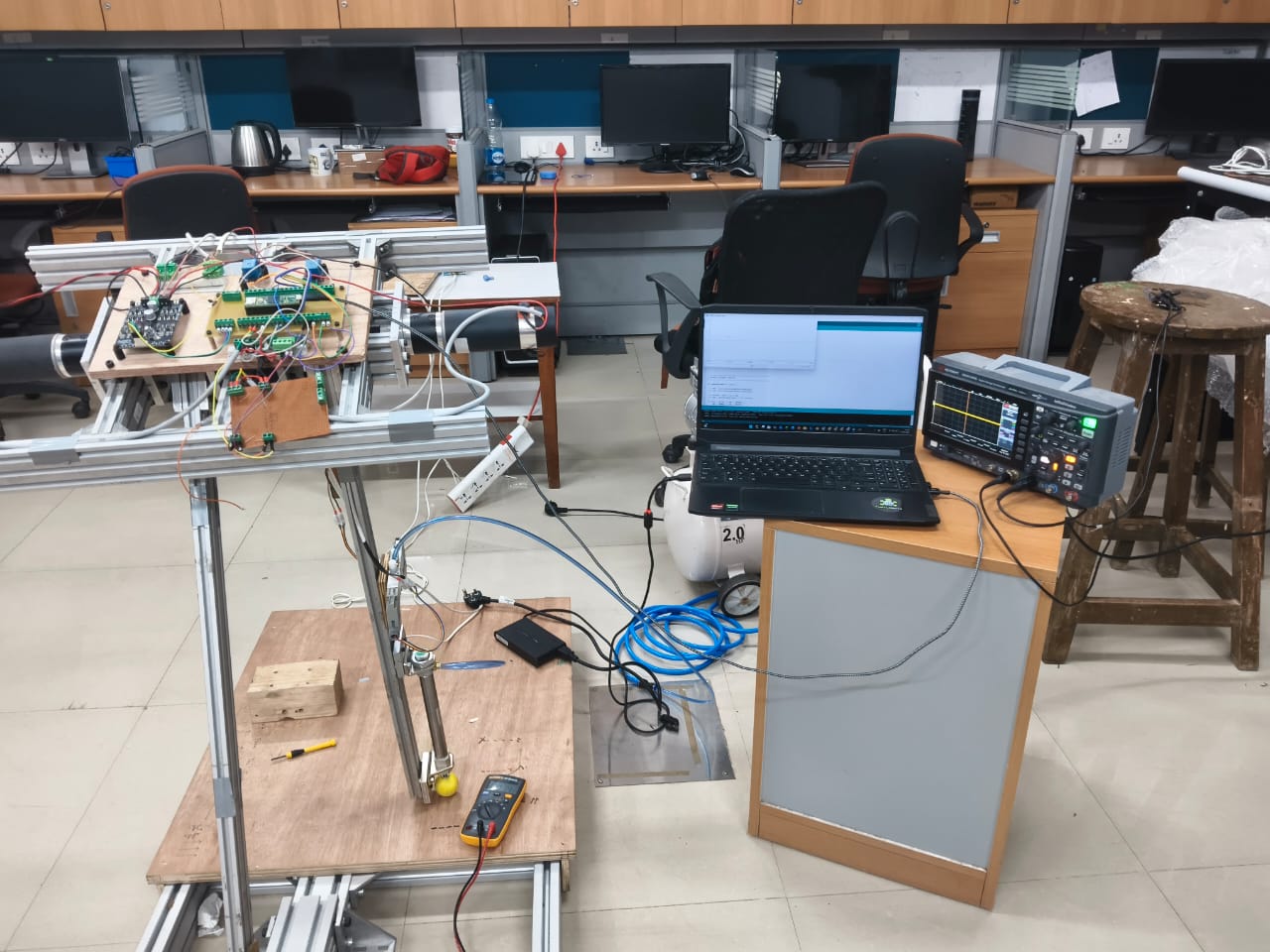
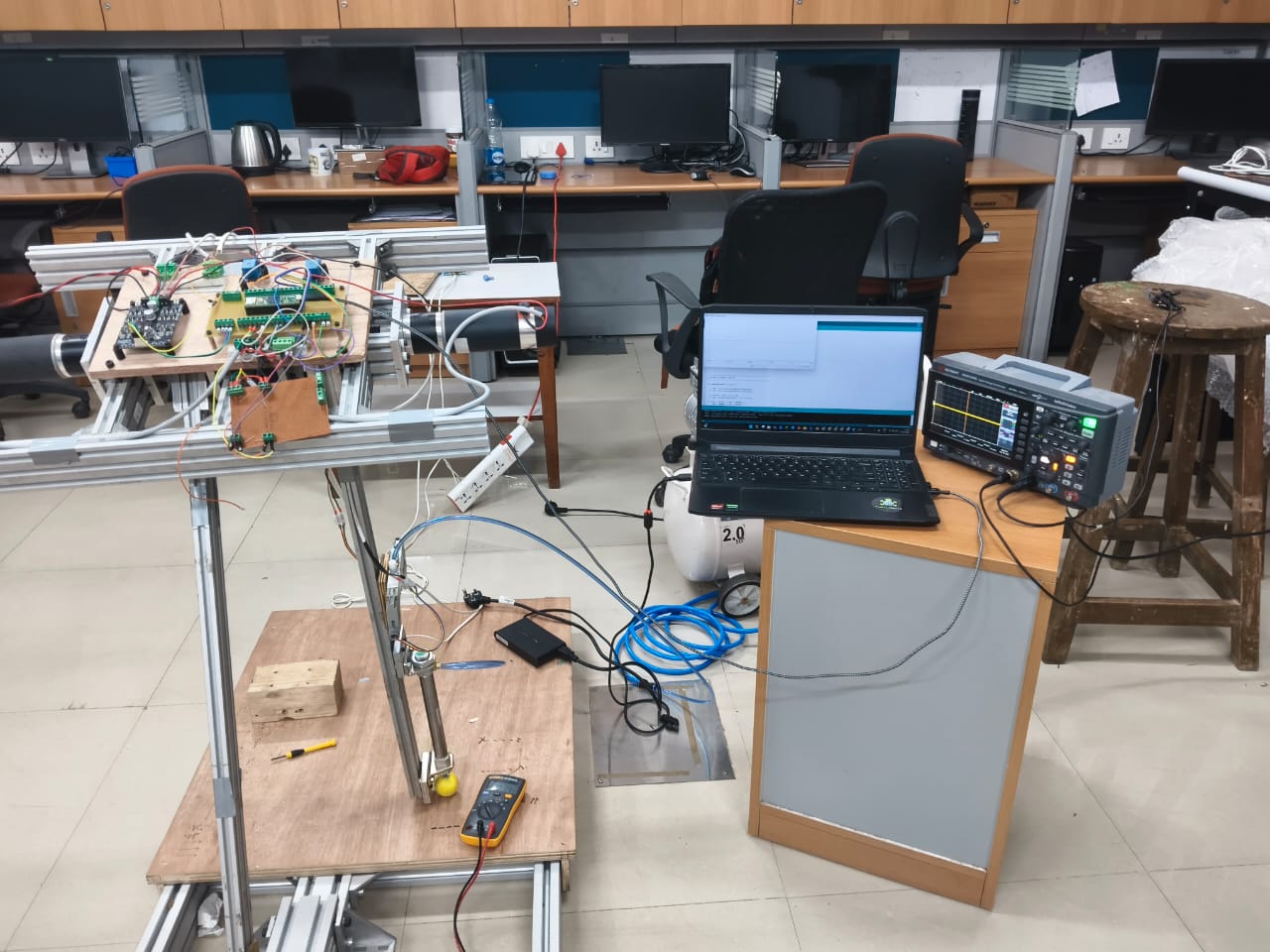
Figure 2: Physical planar bipedal robot hardware setup with pneumatic push-off actuators and dSPACE interface.
Visualizations & Video Demonstration
The physical locomotion framework and simulation rollouts were validated for stepping stability and trajectory tracking.
Simulation Demonstration: Underactuated planar bipedal gait generation with pneumatic ankle push-off.
Progress & Experimental Results
| Phase | Development Focus | Key Deliverables & Achievements | Status |
|---|---|---|---|
| Simulation Framework | Open-Loop & Closed-Loop Dynamics | Built full simulation from scratch; evaluated PID & MPC for target step sizes | Completed |
| Hardware Refurbishment | Actuation & Sensor Integration | Modified mechanical structure, pneumatic/hydraulic lines, dSPACE dynamics modeling | Completed |
| Experimental Validation | Step Tracking & Gait Stability | Tested multiple initial configurations across varying step lengths on physical biped | Completed |
| Foot Kinematics | Continuous-Time Model | Designing custom foot mechanisms and formulating full-system continuous control models | Ongoing |
| Knee Joint Extension | Extended MPC Framework | Integrating knee joints into simulation and expanding hardware to kneed bipedal walking | Ongoing |
| Vision-Guided Gait | Online Trajectory & VLA Models | Developing vision-based online trajectory generation and Vision-Language-Action (VLA) control | Ongoing |
Key Takeaways & Research Directions
- Ankle Push-Off Optimization: Demonstrated that active pneumatic push-off significantly reduces energy consumption and improves limit cycle stability during step transitions.
- End-to-End Pipeline: Successfully constructed a modular dynamic modeling, simulation, and real-time dSPACE hardware testing platform from the ground up.
- Next Horizon: Extending the framework from knee-less locomotion to full kneed bipedal dynamics, while integrating Vision-Language-Action (VLA) models for high-level autonomous navigation.